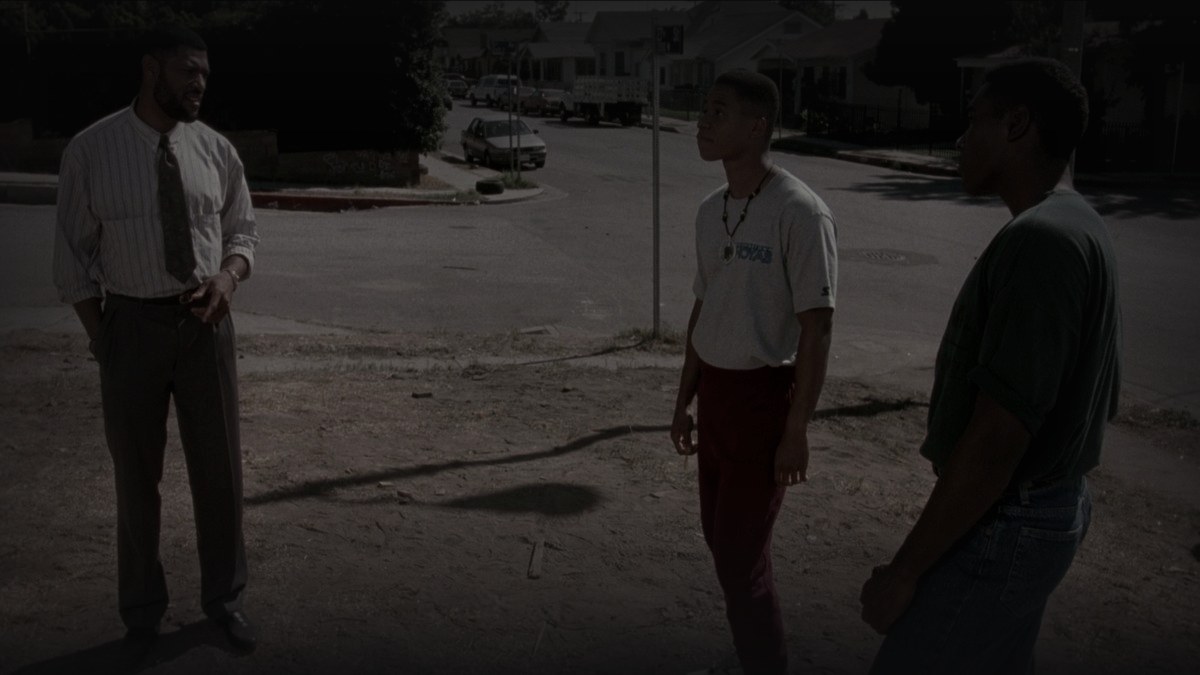
Boyz n the Hood (1991)
John Singleton’s debut, set in south central Los Angeles across two time periods. in 1984, ten-year-old Tre Styles is sent to live with his father Furious after getting into trouble at school. Furious, strict and principled, tries to raise Tre right in a neighborhood where the wrong block, the wrong crowd, or the wrong night can end a life. seven years later, Tre is a teenager with a future. his childhood friends have diverged. doughboy (ice cube) is a crip, fresh out of prison, dealing. his half-brother ricky (morris chestnut) is a star running back with a scholarship shot and a toddler son. the film watches these trajectories collide with the violence that surrounds them.
what the film does
the film is built on the contrast between furious and the neighborhood. furious takes tre to his house, makes him do chores, talks to him about gentrification over a fishing trip at the ocean, and shows him what accountable fatherhood looks like. every other adult male figure is either absent, incarcerated, or dead. the film’s argument is not subtle. it does not need to be. a father who stays is the difference between a kid who survives and a kid who does not.
the LAPD appears as an occupying force. one officer, coffey, is black himself and hostile to the neighborhood in a way the white officer is not. singleton stages this without commentary. the camera just watches. the most unsettling moments in the film are not the shootings but the quieter violences. a helicopter circling overhead at night. a dead body on the sidewalk that children walk past on their way home. a police helicopter that never stops humming.
the third act turns on a chain of retaliation that feels inevitable rather than dramatic. ricky is killed over a gang dispute that has nothing to do with him personally. tre, holding a gun, joins doughboy’s revenge mission but gets out of the car at the last second. his father’s voice wins. doughboy does not get out. he finds the killers, shoots them, and is killed himself two weeks later. the film’s closing title card says doughboy was murdered before the film even reached theaters.
why it is here
singleton was 23. he wrote the script as a film school application, sold it to columbia on graduation, and insisted on directing it himself. the studio let him because they did not expect much. what they got was a film that grossed $57 million on a $6 million budget, earned two oscar nominations, and entered the national film registry eleven years after release. it launched ice cube, cuba gooding jr., morris chestnut, nia long, and regina king. angela bassett is in it for maybe ten minutes and you remember every one of them.
the film belongs in this canon because it does something no other film had done before it in the american studio system. it treats south central as a place where people live, not a problem to be solved. the violence is real and the grief is real, but the film’s center of gravity is the bond between a father and a son. criterion 4: it built the template that menace ii society, juice, south central, and every hood film of the 1990s would follow, and none of them matched its moral clarity.
image: 16:9 still from letterboxd (1200x675 crop variant), baked through scripts/bake_dark_photo.py at default factor 0.45. source luma 91.8, baked mean brightness 32.5 (in canon daylight range). scene: furious styles (laurence fishburne) talking to tre (cuba gooding jr.) and ricky (morris chestnut) on a south central street corner. cross-checked against tmdb backdrops; the letterboxd still is a genuine film frame, not promotional photography.