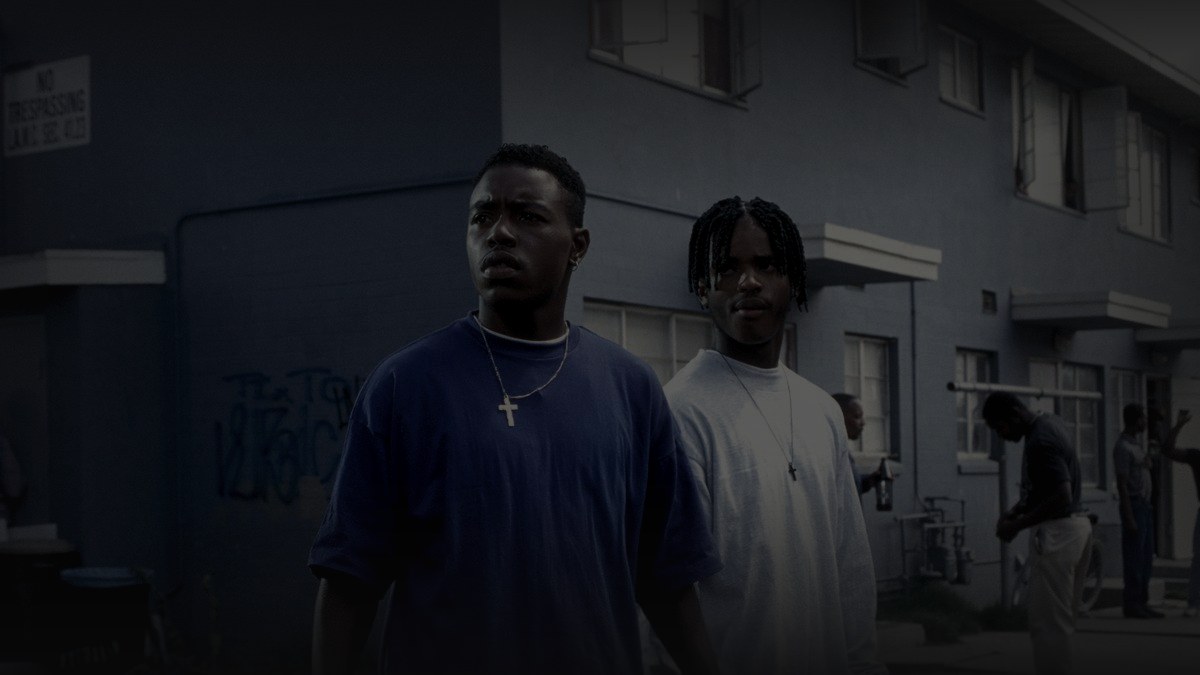
Menace II Society (1993)
A 1993 American teen crime drama directed by Albert and Allen Hughes in their directorial debut. The film follows Kaydee “Caine” Lawson (Tyrin Turner) growing up in the Watts and Crenshaw neighborhoods of Los Angeles, where he is born into a world that has already decided what he will become. His father Tat (Samuel L. Jackson) is a drug dealer killed in a botched deal. His mother Karen (Khandi Alexander) dies of a heroin overdose. Caine is raised by his grandparents in the Jordan Downs housing projects, where he falls in with his best friend Kevin “O-Dog” Anderson (Larenz Tate), and the two join a street gang.
The film was released by New Line Cinema on May 26, 1993, and gained notoriety for its violence, profanity, and drug content. It grossed $30 million against a $3.5 million budget and received critical acclaim for the performances of Turner, Jada Pinkett (in her theatrical film debut), and Tate, as well as the Hughes brothers’ direction. Shot on location in Jordan Downs with residents as extras and the Grape Street Watts Crips working as set security, the film carries a documentary weight that most fiction films about South Central never achieve.
What the film does
The film opens with O-Dog murdering a Korean store owner and his wife over an insult, then stealing the surveillance tape. He plays the tape at parties for the rest of the film. That tape is the structural device: a weapon that circulates, gains power through witness, and eventually reaches the police. The film does not judge O-Dog from outside the frame. It stays inside the world with Caine, watching the consequences pile up without ever telling the audience what to feel.
Caine graduates high school. His cousin Harold is killed in a carjacking. Caine and O-Dog track down and kill the carjackers. Caine becomes a crack dealer. He romances a girl named Ilena, then denies paternity when she becomes pregnant. He is beaten by police and dumped in a Hispanic neighborhood, where rival gang members surprisingly take him to the hospital instead of finishing the job. Ronnie, the imprisoned Pernell’s girlfriend, invites Caine to start over in Atlanta. He agrees, then is killed in a drive-by as he shields Ronnie’s young son Anthony in the film’s final scene. As Caine dies, he recalls his grandfather asking whether he cares if he lives or dies. He realizes he does.
Why it’s in the canon
Criteria blend is 1+3, loved it and want to remember it. Menace II Society is the hood film that does not flinch. Boyz n the Hood (1991) framed South Central through John Singleton’s moral compass, with Cuba Gooding Jr.’s Tre as an audience surrogate who mostly stays out of trouble. Menace II Society has no surrogate. Caine is a drug dealer and a killer. The film does not redeem him. It watches him die protecting a child he has come to love, and asks whether that single act of care is enough to matter.
Tyrin Turner, in the only lead role of his career, gives Caine a quiet emptiness that holds the film together. He is not a performer acting tough. He is a performer showing you someone who has never been given the option of being anything else. Larenz Tate as O-Dog is the film’s live wire, the sociopath who finds the whole thing funny, and the surveillance-tape scenes are still unsettling thirty years later because Tate plays O-Dog as someone who genuinely does not understand what the big deal is. Jada Pinkett, in her film debut, gives Ronnie a weariness that makes the Atlanta escape plan feel real rather than sentimental.
The Hughes brothers were twenty-one when they directed this film. The cinematography by Lisa Rinzler shoots Jordan Downs in natural light, with the color palette of faded stucco and chain-link and late-afternoon sun. The camera holds on faces. It does not cut away from the violence, and it does not aestheticize it either. The liquor store murder is shot in wide, with the camera watching from across the counter. There is no style imposed on the act. It just happens, and the film moves on, the same way the world Caine lives in moves on.
The production history is its own story. Tupac Shakur was originally cast as Sharif, a Muslim ex-knucklehead, but was fired after arguing with the Hughes brothers over the character’s motivation. Six months later, Shakur assaulted director Allen Hughes and was convicted of assault and battery. Spice 1 was set to play Caine. MC Ren was set to play A-Wax. Neither made it into the final film. The cast that emerged, with Turner and Tate and Pinkett and MC Eiht as A-Wax, is the one that stuck, and it is hard to imagine the film any other way.
The film’s legacy is complicated. It was criticized at the time for its violence and nihilism. Roger Ebert gave it three and a half stars and called it one of the best films of the year. Spike Lee criticized it for lacking a moral center. Both were right: the film has no moral center because Caine’s world has no moral center, and the film’s refusal to impose one from outside is what makes it still hit harder than its contemporaries. It is a film about a specific place and time, made by two twenty-one-year-olds who grew up there, and it does not pretend to have answers.
A note on the image
The hero image is a genuine production still from the film showing Caine and O-Dog standing in front of the Jordan Downs housing projects, the setting where most of the film takes place. Sourced from letterboxd at 1200x675, vision-verified as a photographic still (not poster art). The source had high-key daylight luma of 109.8, so it was pre-darkened at factor 0.72 before baking at factor 0.45 through bake_dark_photo.py. Final output brightness is 27.4, within the canon’s 25-35 daylight range. A second source from TMDB (3840x2160 backdrop) was also vision-verified as a genuine still but the letterboxd source was preferred for its exact 1200x675 fit.
On hand
Yes, DVD. No digital or download.
image: 16:9 still from letterboxd (1200x675, source luma 109.8), pre-darkened at 0.72, baked through scripts/bake_dark_photo.py at factor 0.45, output brightness 27.4